

The Intergovernmental Panel on Climate Change (IPCC) is the leading United Nations body for assessing science related to climate change. Created by the World Meteorological Organization and the United Nations Environment Programme in 1988, the IPCC undertakes a comprehensive review of the latest climate science to provide a vital shared understanding of the nature of the climate challenge.
The IPCC is also called on to provide input to inform government policies on climate change. One way it does this is through establishing methodologies for national inventory reports of greenhouse gases under the United Nations Framework Convention on Climate Change (UNFCCC). Additionally, the Sixth Assessment Report Synthesis Report was used to inform the stocktaking of countries’ collective progress toward achieving the goals of the Paris Agreement in 2023.
The IPCC produces an assessment report (AR) every five to seven years which consist of separate contributions from Working Group I (The Physical Science Basis), Working Group II (Impacts, Adaptation and Vulnerability), and Working Group III (Mitigation of Climate Change). Assessment reports can also include additional products, such as special reports and methodology reports, as well as reports from expert meetings and workshops. The cycle typically wraps up with a synthesis report, which summarizes all findings from previous reports during the assessment period. Currently, the IPCC is preparing reports for its seventh assessment cycle (AR7), which began in July 2023 and will end by or during 2030.
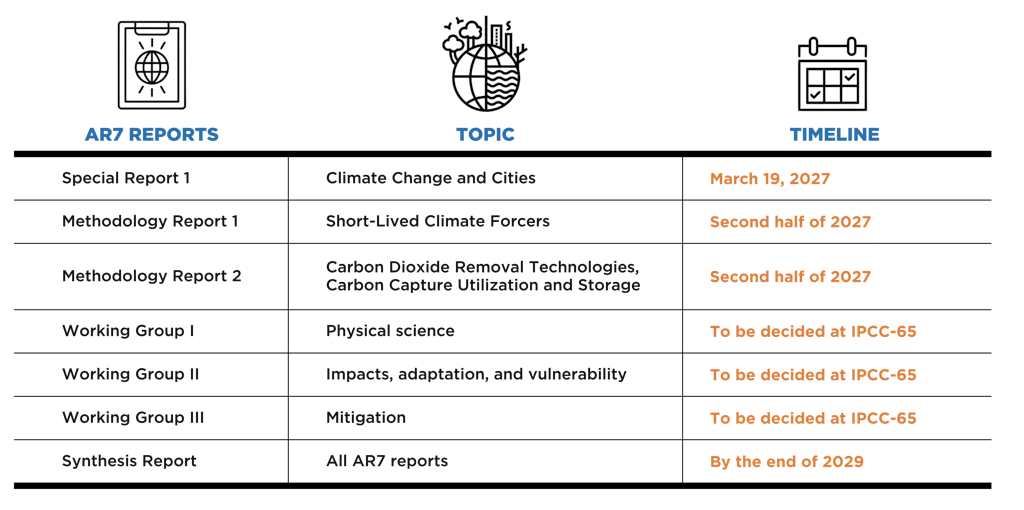
The cycle will consist of reports from each Working Group, the timing of which will be decided at IPCC-64:
An update to the 1994 Technical Guidelines for Assessing Climate Change Impacts and Adaptations, and adaptation indicators, metrics and methodologies, to be developed in conjunction with the WGII report.
A Special Report on Climate Change and Cities (SRCC) by March 19, 2027.
A Methodology Report on Short-Lived Climate Forcers (MR-SLCF) during the second half of 2027.
An Expert Meeting of the Task Force on Inventories for Carbon Dioxide Removal Technologies, Carbon Capture Utilization and Storage and provide a Methodology Report during the second half of 2027.
The cycle will conclude with a synthesis report as soon as possible after the conclusion of the working group reports by late 2029.
October 2026
The IPCC Bureau and member governments will convene for the Sixty-Fifth Session of the IPCC (IPCC-65) in Addis Ababa, Ethiopia.
March 24-27, 2026
The IPCC Bureau and member governments will convene for the Sixty-Fourth Session of the Panel (IPCC-64) in Bangkok, Thailand.
Learn More
February 10-12, 2026
The IPCC will convene experts for two workshops in London, United Kingdom.
Learn More
January 12-16, 2026
The Third Lead Author Meeting of the Special Report on Climate Change and Cities (SRCC) took place in Oslo, Norway.
Learn More
October 27-30, 2025
The IPCC Bureau and member governments convened for the Sixty-Third Session of the Panel (IPCC-63) in Lima, Peru.
Learn More
February 24-28, 2025
The IPCC Bureau and member governments convened for the Sixty-Second Session of the Panel (IPCC-62).
Learn More
KEY RESOURCES AND ARTICLES
Latest Updates from the IPCC
Participating in the IPCC
Sixth Assessment Report


