


 What We DoIssuesGlobal HealthGlobal Health Resource CenterUnderstanding Pandemic Risk Early Enough to Act: A New Partnership for Asia and Beyond
Written by: Celynne Balatbat, Senior Officer, Global Health Strategy, United Nations Foundation
COVID-19 demonstrated the enormous costs of pandemics, but also how much can be mobilized once a crisis is underway. Governments, scientists, philanthropies, businesses, and communities moved quickly and at extraordinary scale. Much of that action, however, came after the risk had already become a crisis.
Since then, most efforts have focused on strengthening preparedness and response. But an important gap remains: we lack a systematic way to understand where pandemic risk exists, what is driving it, how it is changing, and what those changes mean for decisions before a crisis begins.
As Vernon Lee, Chief Executive Officer of Singapore’s Communicable Diseases Agency, explains it: “We can’t respond to what we can’t see.”
That is part of the challenge pandemic risk assessment (PRA) is designed to address. It brings together evidence on the factors that shape pandemic risk, from land-use change, intensive agriculture, wildlife trade, and climate change to urbanization and global travel, and assesses how those conditions are changing over time. The aim is not to predict the next pandemic, but to understand risk well enough to inform better decisions in the face of uncertainty.
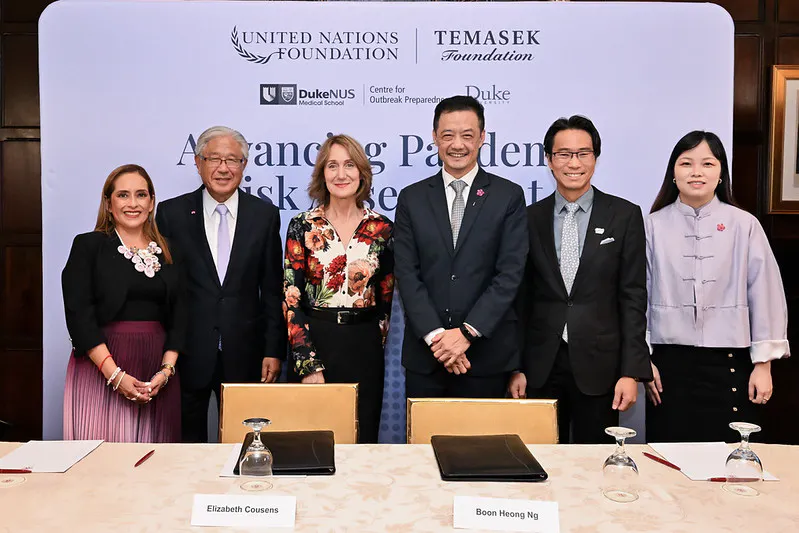
Turning that idea into something useful requires connecting the science of assessing pandemic risk with the institutions that ultimately need to use it. That is the focus of the new initiative “Advancing Pandemic Risk Assessment in Asia,” developed by the UN Foundation, Duke University, and the Duke-NUS Centre for Outbreak Preparedness, in partnership with Temasek Foundation. The partnership was formally launched on September 22, 2026 on the sidelines of the UN General Assembly.
The new initiative will advance the scientific foundation for PRA while working with institutions across Asia to explore how better information about pandemic risk could inform real decisions.
The partnership builds on an Asia regional workshop held in Singapore in July 2026. Those discussions reinforced an important principle for the next phase of work: the science will only be useful if it connects to the choices governments, public health institutions, and funders actually have to make. Asia brings extensive experience managing infectious disease threats, deep scientific and public health expertise, and strong links between science and policy. The initiative will draw on regional expertise, data, institutions, and priorities to help shape PRA itself, while generating lessons that can inform its broader global development.
The partnership also reflects the role philanthropies, such as Temasek Foundation, can play in supporting an emerging approach like PRA. Early philanthropic investment can create space to develop and test new tools, understand where they add value, and build the evidence needed for governments and other institutions to consider how they might be used at greater scale.
Governments and other institutions already make decisions about how to best address pandemic risk. Better information could provide a stronger basis for those choices.
For public health institutions, that could mean deciding which threats deserve closer surveillance, where prevention could have the greatest impact, which capabilities warrant investment, or how much preparedness is proportionate to the level of risk.
Financing is one of the clearest examples where a PRA could prove helpful. We largely finance pandemics once they become observable events. At the initiative launch, Mukesh Chawla, Senior Fellow at the UN Foundation, recalled his experience at the World Bank during the 2014 West Africa Ebola outbreak. Money was mobilized, but by the time it arrived, cases had multiplied, trust had eroded, and the economic damage was compounding.
Acting before a crisis means making financing decisions with much less certainty. Governments and funders must decide where resources are most needed, what risks justify action, how much investment is proportionate, and when to activate financing. PRA could bring more science and rigor to those decisions by providing a stronger basis for understanding risk, uncertainty, and potential consequences. It will not eliminate uncertainty, but it could give governments, philanthropies, development finance institutions, insurers, and others greater confidence to invest before a crisis is underway.
As Chawla put it: “Now I’m not financing an outbreak; I am financing the risk of an outbreak.”
There are significant scientific and practical questions still to work through.
For many pathogens, the data needed to characterize spillover and other dimensions of risk remain incomplete. But the answer cannot be to wait for perfect information. An initial PRA can draw on the evidence that exists, be clear about uncertainty, and help identify where better data are most needed.
PRA also needs to be built around real decisions. Rather than developing an analytical framework in isolation and then looking for applications, the initiative will work with decision-makers to identify where better risk information could change planning or investment. Early analytical approaches can then be tested against those decisions and improved over time. This is a central part of the work in Asia.
Over the coming year, the initiative will advance the science, develop and test a first-generation analytical prototype, and work with institutions in the region to explore concrete applications. The initiative will also continue to bring together the scientific, public health, policy, and financing expertise needed to develop PRA.
The immediate objective is not a definitive assessment of pandemic risk. It is to test what is useful, learn what is feasible, and understand what a longer-term effort in the region and beyond would require.
Pandemics will always involve uncertainty. The question is whether that uncertainty means waiting until a threat has become a crisis before acting. Better information about pandemic risk could help change where we look, what we prepare for, where we invest, and when we act. PRA will only be valuable if it ultimately improves those decisions.
As UN Foundation President and Chief Executive Officer Elizabeth Cousens put it at the partnership launch, the ambition is to strengthen our collective ability “to understand pandemic risk early enough to act early enough.”
Last updated: October 19, 2026
Celynne Balatbat is a Senior Officer for Global Health Strategy at the United Nations Foundation, where she supports strategy development, policy analysis, and stakeholder engagement across key issues including pandemic risk assessment, malaria, and climate and health.
To get the latest Global Health news from our experts, subscribe to our newsletter.