


 What We DoIssuesGlobal HealthGlobal Health Resource CenterAfter UNGA 81: Can the UN’s Flagship Health Meetings Remain at the Center of Global Health Diplomacy?
Written by: Camden Malone, Officer, Global Health Policy, United Nations Foundation
It is September 2014. The Zaire ebolavirus is spreading through West Africa faster than health workers can contain it. Alarmed leaders hold an emergency meeting at the United Nations Security Council, and one day later, the General Assembly unanimously agrees to launch a historic UN-led response.
Twelve years later, another Ebola outbreak is unfolding – this time involving the Bundibugyo strain in the Democratic Republic of the Congo. The outbreak has exposed persistent gaps in early detection and the availability of vaccines and treatments. However, the political circumstances are very different from 2014. At the High-Level Meeting (HLM) on Pandemic Prevention, Preparedness, and Response (PPPR) in New York in September 2026, countries were unable to reach consensus on a political declaration, though it eventually received overwhelming support in a General Assembly vote. Meanwhile, in Geneva, countries remain split over how they will share outbreak data for research and development purposes and ensure that resulting countermeasures are available to those who need them most. As the Bundibugyo outbreak tests global health cooperation in real-time, health diplomacy is under pressure to deliver.
For decades, the UN General Assembly has provided a rare forum where science and foreign policy come together at the highest political level, and where every nation, from small island developing states to great powers, has a seat at the table. Through its HLMs, the General Assembly has helped elevate health challenges on the international agenda, establish shared priorities, and mobilize political attention.
Yet today, the fracturing of international norms is eroding collaboration on critical global issues. While this shift jeopardizes the UN’s role as a global agenda-setter, it also opens an opportunity to rethink how health diplomacy in New York can still contribute to international cooperation.
Seizing that opportunity starts with understanding why New York became another hub for global health diplomacy, what it has accomplished, and how it must evolve.
While the World Health Organization in Geneva remains the heart of global health governance, some health challenges require political attention and coordination across the wider political spectrum. They call for the engagement of Heads of State and Government, and coordinated responses throughout the entire UN system and national cabinets.
New York provides a forum for precisely these discussions. Leaders weigh domestic interests against global responsibility – from security and climate change, to trade and artificial intelligence, human rights, democracy, and reform of the UN itself. Health is a core component of this statecraft, because governments increasingly realize these issues are among the gravest threats to the well-being of their populations.
Health has claimed a growing share of the New York agenda over the last 25 years, with the HLM as its signature format. The tradition of health-related HLMs dates back to 2001, when the General Assembly convened a meeting on HIV/AIDS. Issues are typically elevated to this forum through champion countries and regional blocs. The Caribbean Community (CARICOM), for instance, has advocated for action on non-communicable diseases, while the inaugural meeting on PPPR in 2023 emerged out of a cross-regional response to an acute threat.
Coalitions of like-minded countries, often organized as “Groups of Friends,” work year-round to build support for various causes and sustain policy ambition. Even with strong champions, issues that collide with powerful interests often stall, like diversified manufacturing of medicines, health taxes, and the social conditions that shape health outcomes; while less contentious ones, like the health workforce, disease surveillance, and humanitarian coordination, more readily win support.
The principal outcome of an HLM is a political declaration through which countries establish shared priorities and adopt commitments. As instruments of ‘soft law,’ these declarations are non-binding and deliberately aspirational, creating flexibility for implementation across diverse national contexts. Their value is to support normative alignment and help move relevant actors in the same direction. Legally binding ‘hard law’ instruments such as treaties offer stronger accountability but are harder to negotiate, as the delays on both the Pathogen Access and Benefit-Sharing annex to the WHO Pandemic Agreement and the UNEP plastics treaty illustrate. A political declaration offers space to explore solutions and build consensus at a lower negotiating cost.
However, the impact of political declarations are not always clear. The early HIV/AIDS meetings stand out as high points since they’ve correlated with increases in global funding and decreases in global disease burden. The first declaration on antimicrobial resistance in 2016 drove major governance innovations, though the ambitious 2024 declaration has yet to see the same traction.
The strongest declarations do not overpromise. They help consolidate priorities, set achievable targets, and fill clear policy gaps. However, they are ultimately a negotiated outcome, shaped by competing interests and compromise. Their real value rests on countries’ follow-on actions to implement their commitments.
The power of political declarations stems from being adopted by consensus. This approach yields space for countries to hold reservations on specific provisions while still embracing the outcome as a whole. When a declaration falls short of consensus and must be put to a vote, countries widely view this as a signal of division that weakens the declaration’s normative authority. Diplomats have routinely navigated disputes on intellectual property, economic sanctions, and language on sexual and reproductive health, making trade-offs to preserve the sanctity of consensus rather than risk undermining the outcome with a vote.
In recent negotiations, a hardening U.S. position has shown how the requirement for consensus can become a tool of unilateral pressure. In the last two years, voting on political declarations has become the default rather than the exception. This shift is not limited to health diplomacy in New York. This year, the Commission on the Status of Women failed to adopt an outcome by consensus for the first time in the forum’s eighty-year history. At WHO, where consensus is synonymous with the “spirit of Geneva,” encroaching geopolitics have pushed delegates to vote more often.
The latest PPPR declaration illustrates this challenge. After U.S. objections prevented its approval by consensus at the HLM, the declaration eventually passed by an overwhelming majority vote, echoing last year’s process on non-communicable diseases.
Yet ahead of upcoming negotiations on UHC in 2027, countries continue to pursue the more difficult path of consensus. There are reasons for doing so. Engaging major powers may bring disruption, but their participation lends political salience that no alternative can match. This is the double-edged nature of consensus.
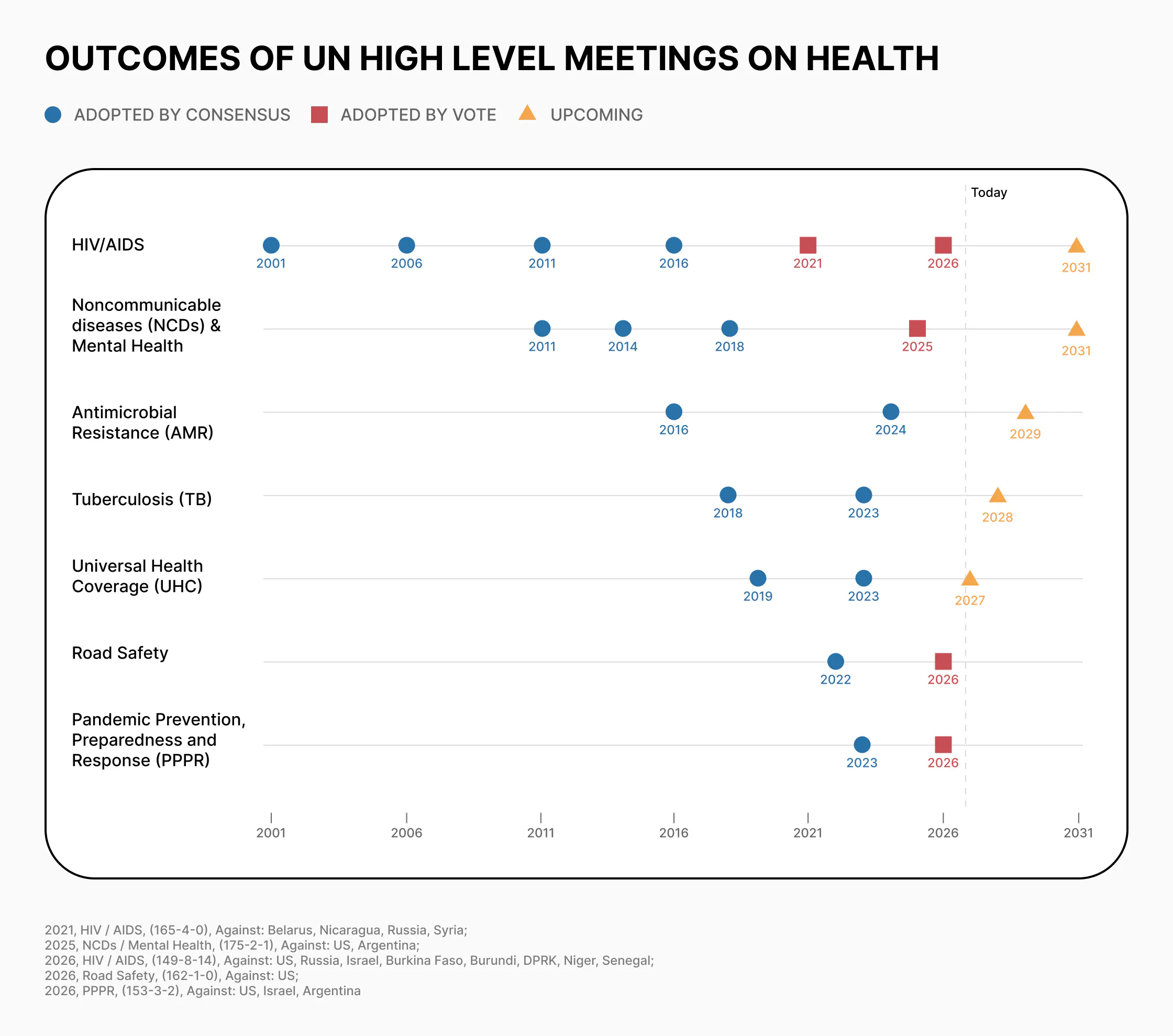
Despite their potential for driving momentum, recent HLMs have raised questions about whether the format is producing diminishing returns, and a small minority now question whether global health belongs in New York at all. Yet bids to bring new topics, such as polio, to the HLM agenda suggest the forum remains a sought-after platform for elevating health priorities. Regardless, the UN General Assembly is booked with health HLMs through at least 2031. The key question is how to make these discussions more impactful.
Revitalizing the HLM calls for strengthening its two most basic functions: drawing political attention to an issue and sourcing solutions from across the ecosystem, including government, science and academia, business, and civil society. Recent meetings have drifted from both.
The decline in attendance by national leaders is one sign of the challenge. The recent PPPR meeting attracted just two Heads of Government and no Heads of State, down from 13 in 2023. In their heyday in the 2010s, these meetings regularly attracted dozens of presidents and prime ministers, at times climbing above 30. Attendance alone does not determine a meeting’s influence and the reasons for declining participation are complex. However, the trend is significant for a forum whose distinctive value is in bringing health issues to the highest levels of government. Scheduling is one factor within the UN’s control. This year’s meeting took place on a Friday, when many national leaders had already left New York. If HLMs are intended to attract the highest levels of government, they should take place earlier in the week, when leaders are more likely to be present.
The second function depends on who can contribute to the HLM process and shape its outcome. Greater use could be made of preparatory multistakeholder hearings to bring diverse perspectives into the process earlier and help inform the priorities taken forward in negotiations. In addition, participation in the HLM itself also remains a challenge. Travel restrictions alongside limited accreditation at this year’s meeting created barriers for meaningful participation from the multidisciplinary experts best placed to inform the deliberations. These barriers are not simply logistical challenges but matters of equity. More timely and predictable accreditation and communications would help ensure that administrative delays do not become another barrier to participation.
Global health is navigating a “once or twice in a century” political moment. Moments like this are both the UN’s reason for existence and impetus for evolution. No institution rivals the UN’s political legitimacy and breadth of representation, and none is better built to carry shared norms through the times of upheaval. HLMs can harness those strengths to expand health diplomacy, even and especially in a constrained and contested environment.
Last updated: October 19, 2026
Camden Malone is an Officer for Global Health Policy at the United Nations Foundation. Based in New York, he works closely with UN Member States and global health partners to advance critical policy priorities, including universal health coverage, antimicrobial resistance, and global health security. Camden also leads the analysis of global health governance and reform processes at the UN in New York and the World Health Organization in Geneva.
To get the latest Global Health news from our experts, subscribe to our newsletter.